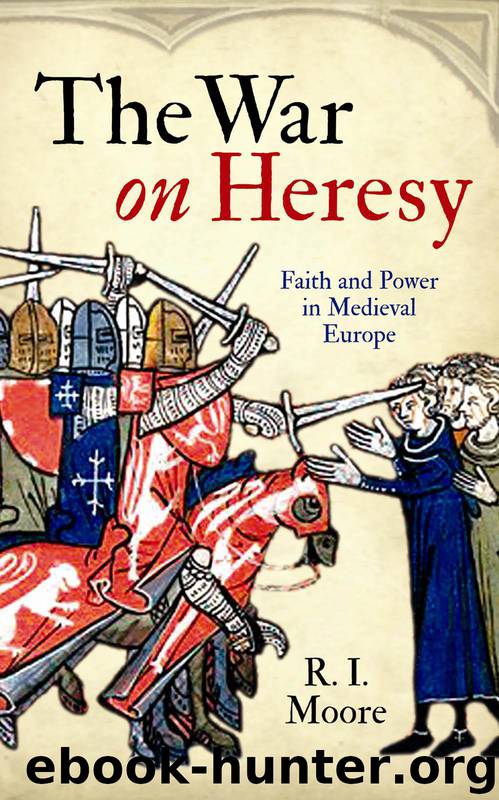
The War on Heresy by R. I. Moore
Author:R. I. Moore
Language: eng
Format: mobi
ISBN: 9780674065826
Publisher: Belknap Press
Published: 2012-04-02T00:00:00+00:00
12
DRAWING THE LINES
‘It’s too late to correct it,’ said the Red Queen: ‘When you’ve once said a thing that fixes it, and you must take the consequences.’
Lewis Carroll, Through the Looking Glass
At Venice in July 1177, following his defeat at Legnano by the forces of the Lombard League of Italian cities in the previous year, the emperor Frederick Barbarossa formally acknowledged Alexander III as pope and abandoned his own anti-pope, Calixtus III. The eighteen-year schism in the papacy was over. As part of the peace it was agreed that the end of the schism should be marked, like that of its predecessor in the 1130s, by an ecumenical council to settle the accumulated problems of the church. In September 1178 some one thousand prelates, including more than three hundred bishops of the Latin church, met at the Lateran Palace in Rome.
The first resolution of this council, Lateran III, that to prevent future schisms only cardinals might participate in the election of a pope, which would henceforth require a two-thirds majority, was of lasting importance. Otherwise, in accordance with the essentially celebratory nature of the occasion, its canons for the most part affirmed and clarified uncontroversial decisions of earlier councils in respect of the discipline of the clergy, the prompt filling of vacant positions in the church, the protection of ecclesiastical property and so on. But the papal and imperial officials who prepared the council’s business had been able to agree, if not on much else, on the perfidy of heresy and the urgency of action against it. Accordingly it was resolved that
since in Gascony and the regions of Albi and Toulouse and in other places the loathsome heresy of those whom some call the Cathars, others the Patarenes, others the Publicani, and others by different names, has grown so strong that they no longer practise their wickedness in secret, as others do, but proclaim their error publicly and draw the simple and weak to join them, we declare that they and their defenders and those who receive them are under anathema, and we forbid under pain of anathema that anyone should keep or support them in their houses or lands or should trade with them. If anyone dies in this sin, then neither under cover of our privileges granted to anyone, nor for any other reason, is Mass to be offered for them or are they to receive burial among Christians.1
In 1184 the mechanisms for enforcing this resolution were completed by the bull Ad abolendam (‘To bring an end to the depravity of various heresies’), issued at a council at Verona by Pope Lucius III, ‘supported by the power and presence’ of the emperor. Heretics and anybody who supported or protected them were to be excommunicated and handed over to the secular power for punishment; bishops who were insufficiently energetic in pursuing them would be suspended for three years. Once or twice a year any parish reported to have heretics living in it was to be visited by the bishop
Download
This site does not store any files on its server. We only index and link to content provided by other sites. Please contact the content providers to delete copyright contents if any and email us, we'll remove relevant links or contents immediately.
| Africa | Americas |
| Arctic & Antarctica | Asia |
| Australia & Oceania | Europe |
| Middle East | Russia |
| United States | World |
| Ancient Civilizations | Military |
| Historical Study & Educational Resources |
Room 212 by Kate Stewart(5123)
The Crown by Robert Lacey(4817)
Endurance: Shackleton's Incredible Voyage by Alfred Lansing(4783)
The Iron Duke by The Iron Duke(4356)
The Rape of Nanking by Iris Chang(4213)
Joan of Arc by Mary Gordon(4112)
Killing England by Bill O'Reilly(4004)
Say Nothing by Patrick Radden Keefe(3987)
I'll Give You the Sun by Jandy Nelson(3447)
Shadow of Night by Deborah Harkness(3368)
Hitler's Monsters by Eric Kurlander(3343)
Mary, Queen of Scots, and the Murder of Lord Darnley by Alison Weir(3210)
Blood and Sand by Alex Von Tunzelmann(3205)
Eleanor & Park by Rainbow Rowell(3175)
Darkest Hour by Anthony McCarten(3133)
Margaret Thatcher: The Autobiography by Thatcher Margaret(3082)
Book of Life by Deborah Harkness(2939)
Red Famine: Stalin's War on Ukraine by Anne Applebaum(2934)
The One Memory of Flora Banks by Emily Barr(2863)
